Help Support NATWA II with beautiful artwork made by Taiwanese women!
10% off for the holidays! All proceeds benefit NATWA II!
Please email for purchase information: giftshop@natwa2.org
Sandcarvings from Chi Chi Town in Nantou County
Taking on the challenge of the WTO and the 9/21 Earthquake集集影雕 (南投縣集集鎮)
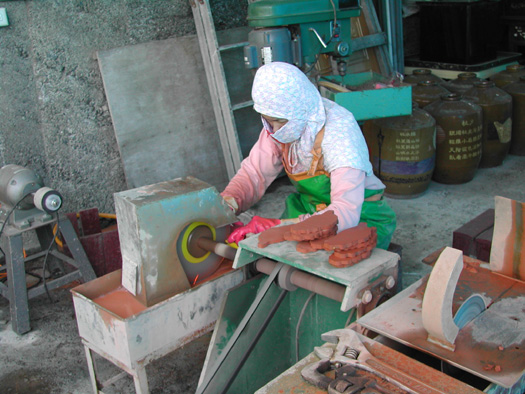
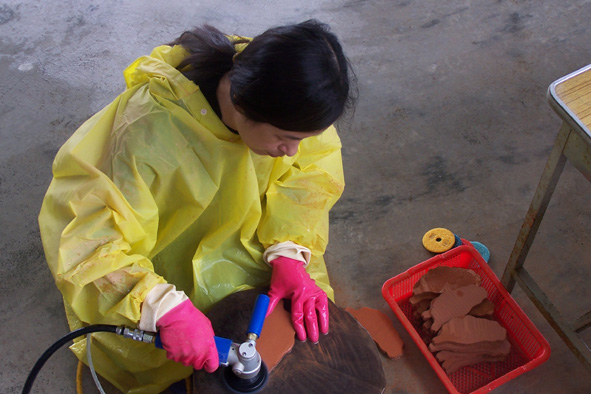
走出九二一以及WTO的衝擊 --- 集集女性重建社區When the World Trade Organization (WTO) announced Taiwan’s admission to the WTO, some of the local farmers in Chi Chi Town of Nantou County (in central Taiwan) also felt excited, like many other Taiwanese, about Taiwan’s admission into one of the world’s major international organizations. Facing the challenges caused by the earthquake and the WTO, several local residents formed Chi Chi Sandcarving Studio in 2001 out of a simple yet determined thought: we shall overcome. Their project is to transform local natural materials into works of art and handicrafts, thus generating crucial income for the community.
Sandcarving, the art of carving or etching directly onto surfaces, creatively combines painting, photography, and carving. Although the studio ended in 2006 due to lack of funding, Ms. Chiu-Hung Huang, one of the key members, continued the journey in the face of financial challenges, presenting Taiwan’s natural and cultural sceneries to the world through sandcarving creations. 世界貿易組織(WTO) 宣佈接納台灣的時候,在南投縣集集鎮的一些農民也高興終於有國際性組織願意承認台灣。然而他們不久後就開始了解,因為開放農作物進口,受到最大衝擊的其實就是自己。1999年的九二一大地震奪走了二千餘人的生命,財物損失估計高達九十億美金。在地震與WTO的雙重挑戰下,集集的十幾位居民,透過草屯工藝所的培訓成立了集集影雕工作室,秉持著是一個單純的念頭: 我們要靠自己的力量站起來。
影像雕刻工藝為綜合書畫、攝影、電腦影像處理、雕刻等工藝技術的創作,原本開發於廟宇及璧飾,集集影雕運用當地的天然材料—垂手可得的河邊石頭或紅磚,將之轉變為手工藝品或是紀念品的創作。雖然集集影雕工作室因經費不足而解散,核心成員之一的黃秋紅女士,仍堅持藝術創作之路,將台灣本土的景物或人文內涵,以影雕呈現,帶給人們嶄新的文化體驗。
The Sunmoon Lake's Ita Thao Series:
|
||
 |
 |
 |
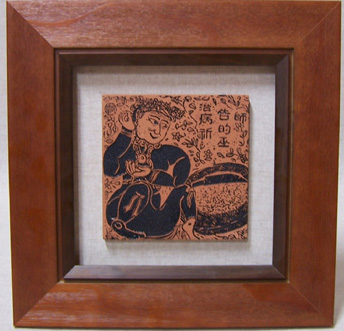
| Hsien Sheng Ma (The High Priestess) The religious and festival rituals of Ita Thao are performed by the High Priestess called "Hsien Sheng Ma." Rituals are important to annual events, weddings, funerals, coming-of-age ceremonies for boys, village construction, as well as ship buildings. The High Priestess serves Pasalar, the highest spirit, and Apu, the spirit of a family’s ancestor, and holds rites of confession and purification for the villagers to bring them peace. She serves not only as a pillar in the religious lives of Ita Thao, but also a comforter and healer of their spiritual lives. 先生媽
|
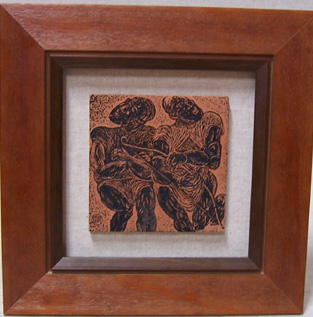
Ita Thao's Mortar-pounding Music (Duet)
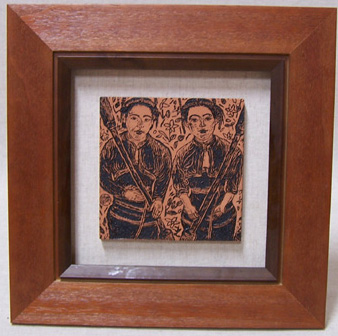
The mortar-pounding music is an essential element of the Ita Thao’s culture. At the end of July of the lunar calendar each year, people meet at the house of the village chief and play the music of mortar-pounding to begin the Harvest Festival. Whenever a major event is happening in the village, the music of mortar-pounding arises in the air among the Ita Shao tribe. The tools used in the mortar-pounding are called mazbabiar, which vary in length, shape and weight. People surround the mortar and pound it at their respective rhythms and tempos, creating music with harmonious rich layers. 伊達邵舂石音 (雙人組)
|
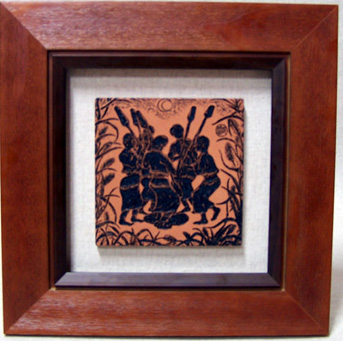
Ita
Thao’s Mortar-pounding Music (Group) The mortar-pounding music is an essential element of the Ita Thao's culture. At the end of July of the lunar calendar each year, people meet at the house of the village chief and play the music of mortar-pounding to begin the Harvest Festival. The tools used in the mortar-pounding are called mazbabiar, which vary in length, shape and weight, thus creating music with harmonious rich layers. Villagers nearby will join with their bamboo pipes of different lengths. On the eve of the Harvest Festival every year, the music of mortar-pounding and bamboo pipes echoes in the air, calling the brave men who went hunting in the mountains to come home and celebrate Ita Thao’s New Year holidays. 伊達邵舂石音 (族群) |
 |
 |
 |
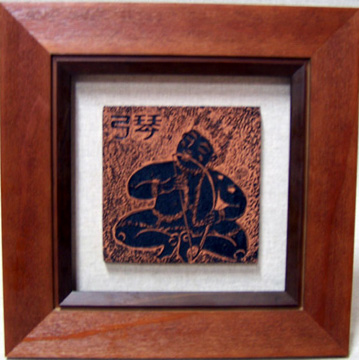
The Arched Lyre
The Arched Lyre is one of the main musical instruments of the Ita Thao. Many of tribe members can play the instrument. During important festivals or during the intervals of farm works, people come together to play the music in harmony. The Arched Lyre is made with bamboo and copper wires. First of all, cut one side of the bamboo to make a long and slender shape. Second, leave the other side in the shape of a pipe of about 8 to 10 centimeters long to be the "sound box." Finally, fasten the copper wires to both sides, and an Arched Lyre is completed. 弓琴
|
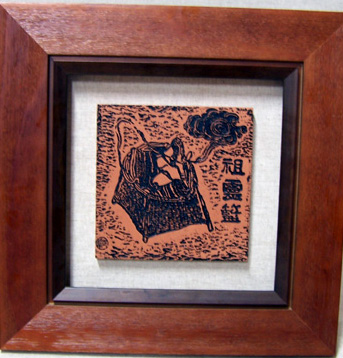
The Basket of the Ancestors' Spirit Piety to the spirit of ancestors is central to Ita Thao's religious beliefs. Every family has a basket of their ancestors' spirit, in which the clothes of ancestors are reserved, representing the existence of the spirit. During important festivals such as the Sowing Festival, the Eel Festival and the Harvest Festival, people always hold religious services to the basket. They offer the ancestors wine and rice while delivering their prayers. 公媽籃 |
The Brave Men of Ita Thao Tribal legends have it that the ancestors of Ita Thao came nearby the Sun-moon Lake while chasing a precious white deer; this was how they came and settled down in the area. The village chief and the elders of Ita Thao once said that their ancestors came from Mountain Ali or somewhere near Tainan, in northern Taiwan. The ancestors seemed to possess the status of "Maotano", which means "brave men", in the southern tribal society. This is why some Ita Thao people took "Mao" (from "Maotano") as their Han Taiwanese last name. 伊達邵勇士 |
The Oceanic Taiwan Series -
|
||
 |
 |
 |
| Water buffalos served as a great resource for the agricultural societies in early Taiwan. Farm work and transportation all depended on these gentle animals. In the 1950s, there were up to 320,000 water buffalos. The number decreased drastically when they were started to be replaced by farming machines. This work depicts a water buffalo bathing in the pond in front of a clay-brick house. It brings into life the close relationship of water buffalos and farming families in the traditional agricultural society of Taiwan. 土确厝前的沐牛 |
People may be surprised how "drifting" plays
an important role in the development of human history. The act of
moving on the water leads to satisfaction for the needs in people's
lives, including transportation, fishing, and exploitation; it also
brought about cultural and economic exchanges, as well as cultural
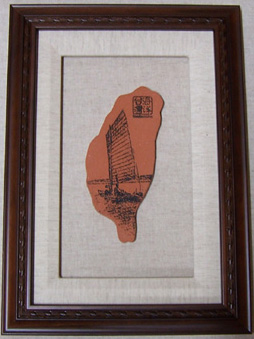
understanding and harmony between different countries and people. 竹筏 |
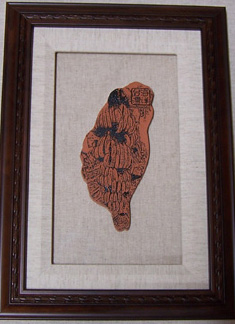
Among Taiwan's exported fruits, banana is the number one in the quantity rank. Bananas growing in subtropical zones like Taiwan are sweet and delicious. The Bananas from Taiwan are widely welcomed by consumers all over the world, and have been exported to Japan for several decades. The picture postcards printed during the Japanese occupation (1895-1945) often feature beautiful ladies and bananas, banana orchards, and trains or steamboats transporting bananas, all showing how prosperous the industry was. In the 1960s, the amount of export per year was as high as 26 million cases. This not only brought remarkable income for Taiwan, but also developed talented people capable of the forthcoming international trades. In Taiwanese Language, the pronunciation of "banana" is close to that of "bring." Hope this artwork will bring wealth and blessing to its owner! 竹筏 |
 |
 |
 |
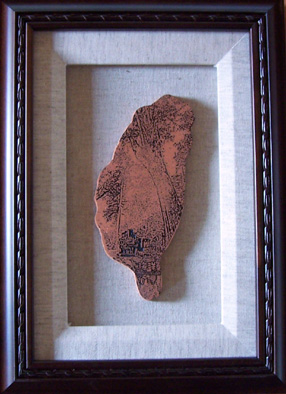
Taiwan has a geographical feature of intensely uneven heights, with rivers short and the water running fast. Ditches and reservoirs for irrigation are devices constructed for such geographical environments. Waterwheels, which could move water to high land, were commonly used in the farming areas of early Taiwan, and they worked on the power of men, animals, and/or water. Bamboo waterwheels used the natural power of the river to push water from low fields to high lands. The craftsmen managed to resolve the problems in their daily lives with their crafting skills by making full use of natural resources such as bamboo. The artwork shows how natural crafting materials and outstanding crafting skills are integrated with people’s daily life in Taiwan. 竹製水車 |
The Sacred Tree of Mount Ali is a huge Taiwanese cypress found by a Japanese technician in 1906. Standing 178 feet high with a circular length of 75 feet, its estimated age is over 3,000 years. Struck by lightening in 1953 and 1956, the internal part of its trunk became carbonized, and boughs on the upper half of it withered completely. Since then the Sacred Tree had been decaying day after day. To avoid accidents that might happen due to the sudden collapse of the tree, Chia-I Forest Administration Office put the tree to the ground in 1998, ending the long history of the symbolic figure of Mount Ali. In the past, in order to export the precious wood to foreign countries like Japan, people chopped down Taiwanese cypress and constructed forest railroads for transportation. Today, environment protection is an important issue and deforestation is completely prohibited. Sight-seeing and tours of high-mountain railroads have become the new attractions of Mount Ali. 阿里山神木 |
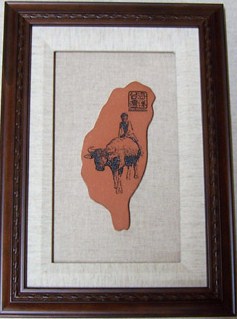
Water buffalos served as a great resource for the agricultural societies in early Taiwan. Farm work and transportation all depended on these gentle animals. In the 1950s, there were up to 320,000 water buffalos. The number decreased drastically when they were started to be replaced by farming machines. This work presents the friendship between a boy and a water buffalo, bringing into life the close relationship of water buffalos and farming families in the traditional agricultural society of Taiwan. 牧童與水牛 |

Please direct comments and questions to natwa2@natwa.com